Tuesday, 20 December 2011

Romantic Films (history)

Romantic films have been around since the late 19th century and although first silent black and white movies have always involved passion, emotion and the affectionate involvement of two main characters and their journey, they often involve the theme and idea of love at first sight, as well as other themes that romantic films could choose to take on these include; unrequited love, obsessive love, sentimental love, forbidden love, sexual and passionate love and tragic love.
Romantic films have evolved over time yet still often include similar plots and cross-over, most plots involved overcoming obstacles such as physical illness, psychological restraints or family that threaten to break the couples love.
Brief Encounter is one of the earliest romance films and is a 1945 film and one of the first landmark British Film about the conventions of British Suburban Life at the period, it centred a house wife who found real love, instead of the polite arrangement between her and her husband and how it can bring unexpected emotions when taken away. It is a film told in first person where the main character ‘Laura’ has a ‘brief encounter’ with another passenger at a train station and decides to meet each other once more. They carry on meeting until their fondness for each other is turning into undeniable love. In the final scene Laura’s bland but kind husband Fred suddenly shows how he has noticed her distress and holds her in his arms,
Dirty Dancing is another very iconic movie and is from 1987 although based in the summer of 1963 it is about the development of a crush that the main female role ‘Baby’ has on the dance instructor ‘Johnny’ at her summer holiday resort. She becomes a substitute dance partner and a romance begins to develop although both ‘Baby’s family and the resort threaten to separate the two from being together. In the end of the film and after being fired Johnny returns to the resort to perform the iconic ‘I’ve had the time of my life’ and the problems are resolved.
Titanic is a 1997 America Romance and disaster movie based on the idea of romance on the ill-fated maiden voyage of the RMS titanic. In this film social class plays the obstacle of their romance as well as the disaster. With the leading female character Rose being a first-class passenger boarding the ship with her fiancĂ© Cal, the male role is a simple artist named Jack who won his ticket for the voyage. After developing a clear fondness for one another Cal forbids Rose to see Jack, although Rose now realises she much prefers Jacks Company over Cal’s even with his third-class manner. She meets up with him and makes love in some of the final moments before the wreckage, when they see the boat hit the iceberg they run off to worn Rose’s mother and Cal. Cal’s jealous character threatens the couple with a gun and after riding the broken ship into the ocean Rose is saved and Jack is left dying from hypothermia.
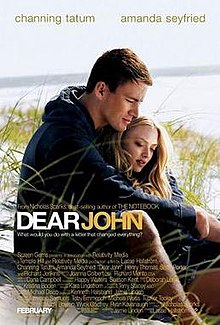
Dear John is a 2010 American romantic film, and is an adaptation of Nicholas Spark’s novel, it follows the life of a soldier who falls in love with a simple young woman within the two weeks he is granted home stay, they decided to exchange letters to each other after he is deployed to war for a year. The year suddenly turns into longer and longer and the two drift apart, the girl marries but her husband gets ill and John (the soldier) returns wounded and helps her raise the funds to make him healthier this doesn’t work and he dies, and in the last scene they see each other outside a coffee shop make eye-contact and they both hug each other.

Monday, 12 December 2011

Target Audience

In marketing and advertising, a target audience, or target group is the primary group of people that something is advertised for in order to find out a target audience for a piece of media different marketing techniques are used. for this project we will use a Target audience questionnaire in which will determine who are target audience are. predicting teenage girls. 
Target audience questionnaire:


1.  Gender?
Male ____         Female___

2.   How old are you?

Younger than 10 ___  10-15 ___  16-18 ___  18-21 ___  21+___

3.What is your preferred genre of movie?

Comedy ___ Horror ___ Fantasy ___  Romance ___  Sci-Fi ___ Musical___  Period drama ___  other please specify ______________  


4.How often do you go to the cinema?

Less than once a month ___1-2 times a month ___3-4 times a month___  More than 4 times a month___

5. What television channels do you tend to watch, if any?

BBC___ ITV___Channel 4/E4___Five___Living TV___ TV___SKY___Other________

6.  Do you enjoy watching romantic comedy’s and romantic films 

  Yes )__  No---

7.  If so do you like sad romantic films?

  Yes --- No---

8.  What types of magazines do you read if any?

Cosmopolitan---FHM---Heat---HELLO!---OK---  ---TotalFilm---

9.  Do you enjoy reading film magazines? 


  Yes --- No ---

10.  What do you find the best way of advertising when it comes to films? 

Billboards---Bus advertisements---Freebies---Magazine---Posters---Radio/television interviews with cast---Trailers---None---
  

Monday, 5 December 2011

Film Titles


when it came to deciding on what to name our film, the group hit a brick wall, we didn't have a clue. because our film trailer comes from a Romantic movie we wanted to combine love words with words related to prison, giving a hint to what happens in the film. we started brainstorming ideas for this and thought a pun would be a good technique to look at, these are some of the ideas we came up with;

we finally decided on the idea of the name 'intimate' which includes an anagram of the phrase in-mate which i think works really well with the ideal plot of the film. when we create the design of the title we will work on separating the two words so the audience are aware of both of the hidden words coming from      title.

these are two of the ideas we had for the film title. i think this technique works really well with the name of the film, and is therefore effective.

Thursday, 1 December 2011

Magazine Covers

On the market today many film magazines are published to reveal the latest hits on the cinema screen to ensure a large swarm of people go check out the latest' it is seen as a great honour to be mentioned or featured in a top film magazine and generally every film that reaches cinema is mentioned in at least one great film magazine, for our project we are going to create a film magazine featuring our movie and in this post I am going to look at two very different film magazine genres. 


first the largest film magazine on the british market


Empire is a British film magazine published monthly since 1989, it is the biggest selling film magazine in Britain and consistently outsells its nearest market rival ‘Total Film’ it reviews both mainstream films and art films but feature articles often focus on large blockbusters. The target audience for tis film is largely male and images as well as the text in the magazine ensure this is relatable. 


and now an artistic American magazine


Interview Magazine is the film magazine we will use in our project out of preference, this magazine combines knowledge of the latest films, music and fashion in one magazine and the films it mainly focuses on are indie movies and small productions similar to the one were planning on making. It is an American magazine which was originally founded in 1969 by pop’ artist Andy Warhol. The magazine focuses on conversations between some of the worlds biggest and most influential celebrities, artists, actors, musicians and creative thinkers. The publication influenced our decisions because of the creativeness and design it uses, and influenced our choices by the design of the front covers.